
Rejuran Pain Relief in Korea: Anesthesia Options and Safety Tips (2026 Guide)
Published:
Rejuran Pain Relief in Korea: Anesthesia Options and Safety Tips (2026 Guide)
Rejuran, also called PN or PDRN treatment, uses polynucleotide from salmon DNA to help skin repair itself. It works deep in the skin to boost collagen, calm irritation, and improve elasticity, fine lines, and pores.
Rejuran is also known for causing more pain than most other skin injections. Many international patients want the results but worry the pain will be too much to handle. This guide looks at why Rejuran hurts and the real ways to make it more comfortable.
Key Takeaways
- Numbing cream is the first step most clinics use for Rejuran pain relief.
- Rejuran HB Plus has lidocaine built in, cutting pain by about half.
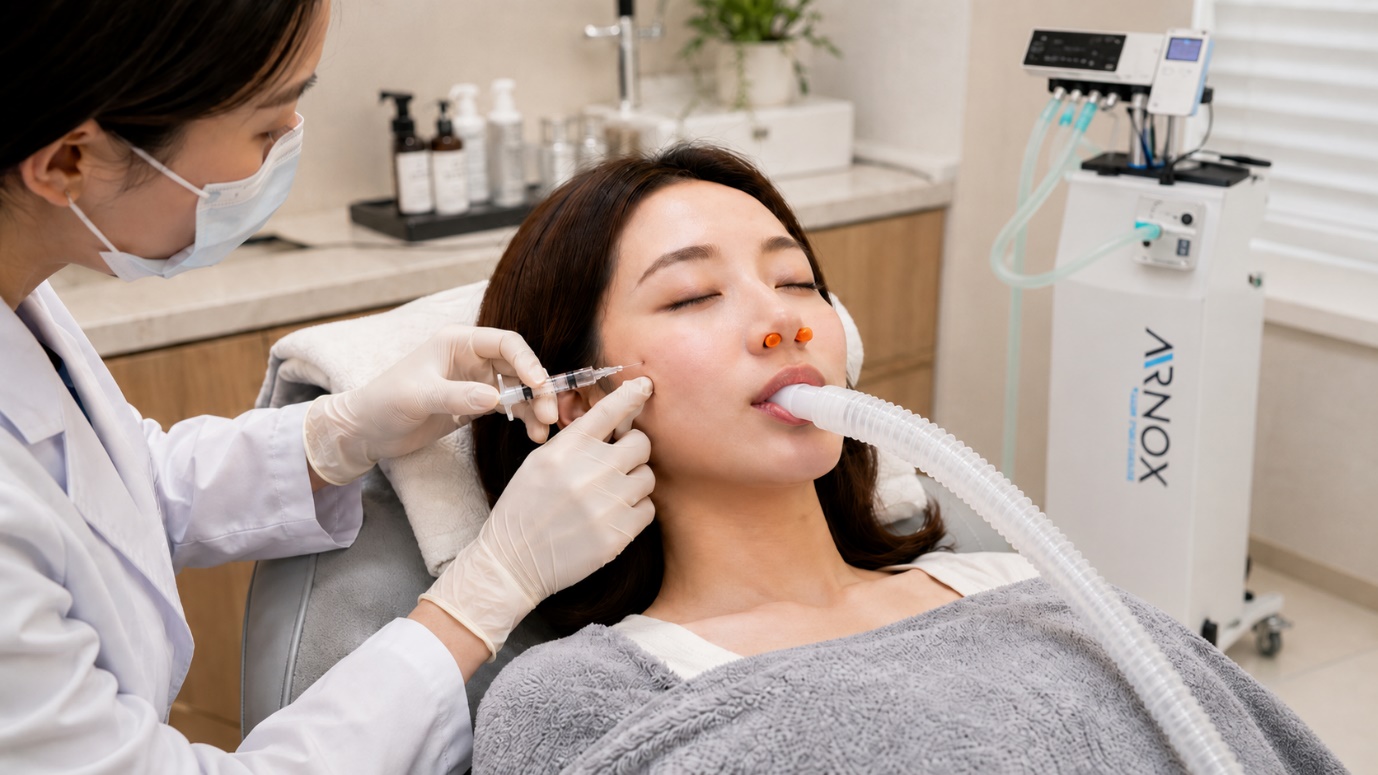
- Nitrous oxide (often called Airnox) keeps you awake but eases pain and anxiety.
- IV sedation removes pain awareness but must be booked well in advance.
- Always confirm your pain relief plan with your doctor before treatment starts.
Why Does Rejuran Hurt?
Rejuran hurts more than most skin boosters because of how thick its main ingredient is. PN has a high molecular weight and a thick, gel-like texture. Pushing it through narrow skin tissue creates pressure that irritates nearby nerves. The needle also needs to reach deep into the dermis to work well. This can cause a sharp, stinging feeling at each injection point. Thin-skin areas like the forehead or under the eyes often feel more sensitive. Because of this, many patients look for ways to ease the sting, from numbing cream to sedation.
Rejuran HB Plus (Lower-Pain Formula)
This upgraded Rejuran already contains lidocaine and hyaluronic acid mixed into the injection. Clinics report it cuts pain by roughly 50% compared with original Rejuran Healer. A 2cc session typically runs ₩240,000–450,000, versus ₩120,000–250,000 for original Rejuran (as of 2026). Many patients pick HB Plus to skip the extra cost of gas or sedation. Ask your clinic if HB Plus is offered before you book.
Topical Numbing Cream
This is the most common first option for Rejuran. A strong topical anesthetic is applied 30 to 45 minutes before treatment. Some sources report it can lower pain scores by roughly 40–60% when timed correctly (as of 2026). It works best for device-assisted Rejuran; manual syringe injections may still feel sharp. Most clinics include this free with treatment (as of 2026).
Local Anesthesia Injection
A lidocaine-based injection can numb the area more deeply than cream alone. It is often combined with topical cream for larger or more sensitive zones. Local anesthesia may cause brief redness, mild swelling, or short-term numbness. Most clinics include this free as part of the treatment (as of 2026).
Nitrous Oxide (Laughing Gas / Airnox)
You breathe this gas through a mask and stay conscious throughout treatment. It reduces pain perception and calms anxiety without putting you fully to sleep. Side effects can include mild dizziness, nausea, or headache, which usually pass quickly. It usually costs ₩70,000–150,000 per session; multi-session packages often lower the price (as of 2026).
IV Sedation (Sleep Anesthesia)
This puts you into a deeply relaxed, sleep-like state during the procedure. You are monitored by an anesthesiologist, and you may not remember the treatment. It carries more risk than cream or gas, including drowsiness, low blood pressure, or nausea. It is not the same as general anesthesia, which is rarely needed for Rejuran. Cost usually runs ₩100,000–300,000, depending on the drug used (as of 2026). Clinics cannot offer sedation alone; it must be paired with an actual treatment.
Common Mistakes Foreign Patients Make with Rejuran Pain Relief
- Skipping the numbing wait time: cream needs 30–45 minutes to work; arriving late can mean more pain.
- Not disclosing health conditions: allergies, heart issues, or pregnancy can change which anesthesia is safe; always share your full history.
- Choosing sedation for convenience alone: stronger anesthesia means more risk; match the method to your actual pain tolerance.
- Not asking who monitors sedation: IV sedation should always involve a trained anesthesiologist, not just the treating doctor.
- Requesting IV sedation on the day of treatment: most clinics need at least two weeks' notice to arrange an anesthesiologist; book this option early.
How to Evaluate Rejuran Pain Relief in Korea: A Checklist
- Confirm which pain relief options the clinic actually offers.
- Ask whether Rejuran is given by syringe or a multi-needle device.
- Check if an anesthesiologist is present for any sedation option.
- Ask about numbing cream wait time and cream strength used.
- Share your full medical history before choosing an anesthesia method.
Insider Insight: What Clinics in Seoul Actually Recommend
Not every clinic offers nitrous oxide or IV sedation as a Rejuran option. If pain relief matters to you, look for a clinic that offers several methods, not just numbing cream. This gives you room to choose based on your own pain tolerance. If you're considering IV sedation, don't just pick the cheapest option. Choose a clinic where a licensed anesthesiologist monitors you throughout the procedure. This matters more than price when sedation is involved.
Where Independent Research Stops Working
This guide can tell you what pain relief options exist and how they generally work. What it can't tell you is which option fits your skin, your health history, and your pain tolerance. A fair price for your specific case, and clear communication with your provider, also depend on your situation. The Contour Journal - SSC offers a free, no-obligation review of your case if you'd like a second opinion before booking.
FAQ
Q. Why do people choose pain relief for Rejuran instead of just enduring it?+
A. Pain relief lets patients complete treatment comfortably without cutting the session short. It also helps first-time patients return for follow-up sessions, which Rejuran usually needs.
Q. Is Rejuran safe with numbing cream, gas, or sedation?+
A. Yes, when performed by a licensed doctor with proper monitoring. Each method carries mild, usually short-term side effects that your doctor should explain beforehand.
Q. How much does pain relief add to the cost of Rejuran?+
A. Numbing cream is often free; nitrous oxide runs about ₩70,000–150,000, and IV sedation about ₩100,000–300,000 (as of 2026). Ask your clinic for a full quote that includes the anesthesia option you choose.
Q. How long is recovery if I choose sedation instead of cream?+
A. Sedation recovery is usually a few hours, compared to almost none with cream alone. Plan to rest at the clinic briefly and avoid driving yourself home.
Q. Do Korean clinics offer English support for pain relief consultations?+
A. Many clinics in Seoul, including Myeongdong, offer English-speaking staff or interpreters. Confirm this with the clinic directly before your appointment, especially for sedation.
Planning Rejuran Pain Relief in Korea?
Rejuran can be a smooth experience when the right pain relief method matches your case. From numbing cream to nitrous oxide to IV sedation, Seoul clinics offer real options. Always discuss your health history and pain relief choice with your doctor before treatment. Send your case details to The Contour Journal - SSC for a free, no-obligation pain relief and clinic recommendation — reach us via {email or phone} or /contact.
Sources
- TT Aesthetics, "Is Rejuran Painful?" — numbing cream approach, pain as a sign of correct depth
- O.N Clinic, "Rejuran pain vs. effect review guide" — anesthesia method, injection speed, and technique affect pain
- Korea Dermatology, "Rejuran Pain Level: What to Expect" — numbing cream timi
Related Articles
 Factory vs. Boutique Clinics in Korea: Which One Fits You? (2026 Guide)→
 How to Make LDM Effects Last Longer in Korea (Hongdae, Seoul Guide, 2026)→
 How to Tell If a Gangnam Skin Clinic Has a Real Dermatologist→
 Is Skin Botox Actually Botox? The Superficial Micro-Injection Secret to Glass Skin (Without the Frozen Face) — A Myeongdong, Seoul Guide (2026)→
 Lifting Treatments in Seoul, Gangnam: The Full Device Cheat Sheet Beyond Ultherapy and Thermage (2026 Guide)→
 Medical Tax Refund for Foreigners in Korea: What Changed and What Didn't (2026 Guide)→